
Surprising fact: privacy in crypto is not a single setting you flip on — it is a stack of independent protections, and failing any one layer can undo the rest. For privacy-focused users in the U.S. choosing a secure multi-currency wallet, that technical stack matters as much as whether a wallet supports Monero, Bitcoin, or less common chains like Haven Protocol. This article lines up Cake Wallet’s multi-asset, device-protected design against the ideas behind Haven (an asset-privacy protocol) and common alternative approaches so you can see not just what each tool does, but where privacy actually breaks or holds under real-world constraints.
I’ll walk through mechanisms (how privacy is achieved), trade-offs (what you gain and what you risk), and decision heuristics (when each setup is a fit). Expect at least one counterintuitive correction: the most privacy-friendly coin does not automatically make the entire setup private — networking, keys, metadata handling, and UX all matter.
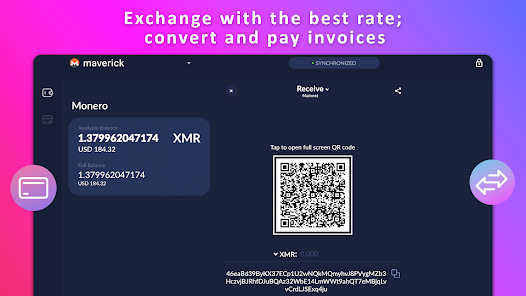
How privacy is layered: keys, transactions, and network separation
Think of privacy as three concentric layers: 1) key custody and device protection, 2) transaction-level privacy features native to each currency, and 3) network-level anonymity (IP and metadata). A weak link in any layer exposes information an adversary can combine with open blockchain data to deanonymize you.
Cake Wallet places strong controls at each level: private keys never leave the device because it’s non-custodial and open-source; device-level encryption leverages Secure Enclave (iOS) or TPM (Android) and local access is protected by a PIN or biometrics; and network privacy is supported with Tor-only mode, I2P proxy, or custom node connections. Those are not cosmetic additions — they are mechanistic defenses. For example, even Monero’s ring signatures protect transaction content from chain analysis, but if your IP leaks at broadcast time, chain-level privacy can be correlated with network metadata. Cake Wallet’s Tor/I2P options reduce that risk.
Haven Protocol (a privacy-oriented asset layer) and coins like Monero aim to minimize linkability at the protocol level. But protocol privacy and wallet privacy are complementary, not redundant. A privacy coin plus a careless network configuration remains vulnerable; conversely, a private network alone can’t fix transparent transaction structures on Bitcoin without coin-control and privacy primitives such as PayJoin.
Comparing primitives: Monero, Bitcoin privacy tools, Litecoin MWEB, Zcash rules, and Haven
At the transaction layer each currency brings different primitives and constraints. Monero’s privacy is built-in: rings, stealth addresses, and confidential transactions are default. Cake Wallet leverages Monero’s model by keeping the private view key on-device and supporting subaddresses and background sync — practical touches that reduce metadata leaks (you can route receipts to subaddresses so a single public address doesn’t reveal aggregate activity).
Bitcoin is different: transparency is default. Cake Wallet integrates Bitcoin privacy tooling — Silent Payments, PayJoin v2, UTXO coin control, and batching — to reduce linkability on Bitcoin. Those tools change transaction arithmetic and participant behavior to break simple heuristics used by chain analysis firms. But they are conditional: for PayJoin to work you need a cooperating counterparty or a compatible service; UTXO control requires user attention; Silent Payments reduce address reuse but depend on wallet and service support.
Litecoin’s MWEB provides an optional privacy layer akin to MimbleWimble; Cake Wallet supports MWEB so users can opt into those privacy-enhancing outputs. Zcash introduces a policy decision: Cake Wallet enforces mandatory shielding for outgoing ZEC, which is a conservative safeguard to avoid accidental transparent spending. That design choice sacrifices some convenience in rare workflows but reduces a common user error that might leak treasury-style metadata.
Haven Protocol’s appeal lies in private synthetic assets and cross-asset privateness. It aims to combine private stable-value assets with confidentiality. Where Haven and similar protocols differ is their design focus: instead of retrofitting privacy onto transparent chains, they create confidential asset rails. The choice between using a privacy coin like Monero, a privacy-enhanced BTC workflow, or a private asset on Haven-style rails depends on your required guarantees: default unobservability (Monero/Haven) versus conditional obfuscation (BTC with PayJoin) and whether you need asset fidelity (stable-value instruments) that Haven targets.
Security trade-offs: hardware integration, device protection, and air-gapped workflows
Cake Wallet integrates with hardware devices (Ledger and the air-gapped Cupcake) to reduce key-exposure risk. Hardware wallets shift the threat model: malware on your phone can’t sign transactions without the external device authorizing them. The trade-off is usability. Air-gapped flows are more secure but slower and can be intimidating for everyday users. For many U.S. users the practical sweet spot is a hybrid: store the bulk of assets in a hardware-backed wallet and use a software wallet (with Tor and strong PIN) for day-to-day privacy transactions.
Device-level encryption via Secure Enclave or TPM is a real security multiplier — it limits offline attacks and key extraction if the device is lost or seized. But it’s not foolproof. Firmware compromise, OS-level vulnerabilities, or coercion (legal or physical) remain threats. In the U.S., legal risk and law-enforcement requisitions are real considerations, so the distinction between technical compromise and compelled disclosure matters. Cake Wallet’s non-custodial approach prevents server-side seizure of keys, but it cannot prevent compelled access to the device unless combined with plausible-deniability workflows or secure off-device key storage.
Where privacy commonly breaks — and how to reduce the most material risks
Three practical failure modes are responsible for most deanonymization in practice:
1) Network leaks at broadcast time. Solution: use Tor/I2P or run your own node. Cake Wallet’s Tor-only mode and the ability to select custom nodes mitigate this, but users must enable and correctly configure these options.
2) Key custody mistakes: reusing addresses, exposing view keys, or using custodial services. Solution: keep keys local, use subaddresses, and avoid unnecessary sharing. Cake Wallet’s policy of never sending private view keys off-device and its zero-telemetry stance lower this risk materially.
3) Cross-chain swaps that reveal linkage. Solution: prefer decentralized routes and avoid custodial bridges. Cake Wallet’s built-in swapping uses NEAR Intents to route trades across market makers — a design that reduces reliance on a single counterparty — but any intermediary involved in settlement can become a metadata aggregator, so check counterparty privacy policies and prefer private routing when available.
Decision heuristics: which setup fits your goals?
If your primary goal is transactional unobservability for payments and receipts, choose Monero-first workflows: a Monero-focused wallet with on-device view-key protection and subaddresses — Cake Wallet fits this profile. If you need fungible stable-value assets privately, a Haven-like approach (private synthetic assets) can be preferable, but it may require trusting protocol-specific mechanisms and liquidity providers.
For Bitcoin users who need both privacy and broad liquidity, combine Cake Wallet’s Bitcoin privacy features (PayJoin v2, Silent Payments, UTXO control) with Tor and hardware signing. This hybrid delivers strong privacy for many practical use cases in the U.S. without abandoning the Bitcoin ecosystem.
If you operate across multiple chains and value convenience, Cake Wallet’s multi-platform availability, built-in swaps, MWEB for Litecoin, and zero-telemetry policy make it a pragmatic hub. For readers who want to try it, the secure single-download point is available here: cake wallet download.
Limitations and unresolved trade-offs
No wallet can make a privacy guarantee in isolation. Open-source, non-custodial code reduces certain systemic risks, but it doesn’t eliminate human error, OS vulnerabilities, or coercion. Some trade-offs are persistent:
– Usability vs. security: hardware and Tor improve privacy but increase friction. Many users disable protective features because they are inconvenient, which undermines privacy in practice.
– Protocol limits: Bitcoin privacy tools are probabilistic and often require cooperation; they do not make Bitcoin fully private. Monero gives stronger default privacy but is less widely accepted on mainstream platforms.
– Migration complexity: protocol differences can create painful edge cases — for example, Zcash migration from Zashi wallets is incompatible with Cake Wallet seeds, so manual transfer is required. That’s a real operational cost some users underestimate.
What to watch next: signals and conditional scenarios
Three developments could change the balance of trade-offs in the near term. First, wider wallet-level adoption of PayJoin v2 and Silent Payments on custodial services would make Bitcoin significantly more private in practice — but that requires industry coordination. Second, better UX for air-gapped and hardware-backed signing could shift more users toward secure custody. Third, regulatory pressure or exchange policies that require increased traceability would raise operational friction for private-asset rails and might push liquidity to more opaque or decentralized channels. Watch for broader ecosystem support for Tor and joinable privacy primitives — those are the signals that privacy becomes practical, not merely theoretical.
FAQ
Does a privacy-focused wallet like Cake Wallet make me anonymous on-chain?
Short answer: not automatically. A privacy wallet provides tools (local key custody, Tor/I2P, coin control, coin-specific privacy features). Whether you become anonymous depends on user behavior, the currency’s inherent privacy primitives, network configuration, and any intermediaries used for swaps or liquidity. Combine protocol-level privacy (Monero/Haven) with network anonymity and hardware-backed keys to get the strongest practical privacy.
Is using Tor or I2P enough to prevent deanonymization?
They are necessary but not sufficient. Tor/I2P hides your IP at broadcast time, which closes a major leak, but metadata can still be revealed through address reuse, unshielded Zcash outputs, or swap counterparty records. Use Tor/I2P alongside subaddresses, mandatory shielding (for ZEC), and careful coin control to protect privacy holistically.
How should U.S. users think about legal risk and privacy wallets?
Technical privacy does not equate to legal protection. In the U.S., compelled disclosure, search warrants, or seizure are real risks. Technical best practices (hardware wallets, air-gapped backups, strong device encryption) reduce the chances of accidental compromise, but they do not remove legal avenues. If legal exposure is a realistic concern, consult a knowledgeable attorney in parallel to technical measures.
Which is better for everyday private spending: Monero, Bitcoin with privacy tools, or Haven-style assets?
For native transaction privacy and broad unobservability, Monero is the simplest fit. Bitcoin with privacy tools is powerful when you need access to the Bitcoin ecosystem and liquidity; it demands more operational care. Haven-style assets are useful if you need private stable-value instruments. Choose based on which compromises (ecosystem access, ease-of-use, liquidity) you can accept.